


Demand for injection moulding is expected to grow significantly in Europe over the next few years. For example, injection moulding demand in Germany is on the rise, with the country’s injection moulding market already accounting for more than 20% of regional revenue.
In this guide, we’ll walk through the basics of how plastic injection moulding works, what goes into making a mould, and how partnering with a contract manufacturer can help you get the benefits of this process without having to manage all the complexities yourself.
What is Plastic Injection Moulding?
Plastic injection moulding is a manufacturing process where molten plastic is pushed into a mould cavity to produce parts. Once the molten plastic takes the shape of the mould, it cools and solidifies.
Example Plastic Injection Moulding Applications & Products
You can use injection moulding to manufacture a wide range of plastic products, from tiny gears for toys to large automotive components like bumpers. Let’s look at a few examples of products manufactured using injection moulding.
Consumer Goods
Injection moulding is commonly used to manufacture consumer goods because it enables mass production of low-cost, durable items.
- Toothbrush handles
- Bottle caps and containers
- Toys
- Kitchen appliances and utensils
- Containers
Medical Devices
Manufacturers of medical devices use injection moulding for products that require precision and cleanliness. It helps them manufacture biocompatible, single-use components and complex assemblies.
- Housings and device exteriors
- Syringe bodies and plungers
- Inhaler housings
- Blood collection tube caps
- Surgical instrument handles
- Diagnostic test kits (casings and wells)
Mechanical Parts
Injection moulding is used in mechanical applications for parts that need to be lightweight, corrosion-resistant, or geometrically complex. It’s especially a popular choice for semi-structural or moving components.
- Plastic gears and bushings
- Bearing housings
- Pump casings
- Fan blades for small appliances
- Cable guides and wire clips
Electronics & Telecommunications
Injection moulding is widely used to create insulating enclosures and components that protect delicate circuits while maintaining an ergonomic design. Here are specific parts injection moulding can be used for:
- Smartphone and tablet casings
- Remote control housings
- Router/modem enclosures
- USB and charger housings
- Wire connectors and insulation grommets
- LED light diffusers
The Plastic Injection Moulding Process
The plastic injection moulding process involves four broad steps. Let’s use the example of manufacturing a manual toothbrush handle with an ergonomic grip with soft-touch rubber inserts.
1. Setting Up the Injection Moulding Machine
Before we move to production, you need to prepare the moulding machine and tooling. There are three things to take care of in this step:
- Install the mould: Securely mount the two-part steel or aluminium mould on the injection moulding machine. This mould gives plastic the shape of a toothbrush. It contains a cavity (for the handle shape), ejector pins, cooling channels, and sometimes inserts for multi-material or over-moulding.
- Configure machine parameters: Parameters depend on what you want to manufacture and the material. Here’s some potential parameters for polypropylene when manufacturing a toothbrush handle, based on your design intent:
-
-
- Injection pressure: 70–120 MPa
- Barrel temperature: 230–240°C
- Mould temperature: 20–60°C
- Injection speed: Moderate to high
- Holding pressure: ~50–70% of injection pressure
-
- Dry cycle: Run machine motions without heating or material to verify mould alignment, ejector function, and lubrication.
2. Choosing the Best Plastic Injection Moulding Materials
The next step is to choose the best material for your part. You need to consider the material’s mechanical properties, thermal properties, chemical resistance, and cost, among other things.
For example, when manufacturing a toothbrush handle, we might use a polypropylene (PP) base with a thermoplastic elastomer (TPE) for the soft grip. PP is strong, lightweight, chemically resistant, and easy to mould, while TPE adds a rubbery, non-slip surface where users grip the handle.
The material you choose may have specific handling requirements. For example, TPE absorbs moisture, so it needs to be dried before use. You might also want to premix or add colourants and other additives (such as antimicrobial agents) through masterbatches.
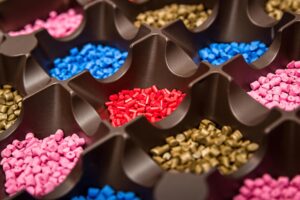
At this point, you’re ready to feed material into the hopper. The hopper drops the plastic pellets into a heated barrel to melt. They’re then pushed forward by a reciprocating screw.
3. Streamlining the Moulding Process
We’re now in production.
In this step, you need to focus on two critical aspects: cycle time and quality.
In our example of a toothbrush handle, the cycle time may be ~15–30 seconds. Here’s what happens during this short time:
- Injection: The machine injects molten PP into the cavity. For multi-material handles (like in our example), a two-shot injection moulding machine might be used. So in our example, the machine injects PP first and then injects TPE into specific zones using a secondary barrel.
- Cooling: Cooling channels in the mould allow water to circulate and cool the part.
- Mould opening and ejection: Ejector pins push the toothbrush handle out of the cavity after it solidifies. High-end machines may have robotic arms to remove the part automatically.
- Quality checks: A person visually and dimensionally inspects the part at this point. You can automate this step if you invest in vision systems or laser scanners.
- Post-processing (if needed): You may need to trim parts if they have excess plastic. If there’s no excess plastic, you can directly send them for pad printing (for branding and indicators) and packaging.
- Cycle optimisation: Monitor OEE (overall equipment effectiveness) to see how the machine performs under set parameters and fine-tune if needed.
4. Recycling and Reprocessing Materials
No matter how much you optimise your processes, you’ll always have sprue waste (excess plastic from channels) and rejected parts (defects or short shots).
To recycle this plastic, collect and granulate it into smaller flakes or pellets using a plastic granulator. Blend the regrinded material with virgin plastic depending on the material’s quality tolerances (this could be 10–20% for PP).
This process can be manual, or you can install closed-loop systems near the machine to automate recycling.
Recycling isn’t always an option, though. For example, only virgin material is allowed due to hygiene or aesthetic requirements of some medical or high-end cosmetic applications.
Advantages of Plastic Injection Moulding
Now that you know the process, let’s look at a few advantages of plastic injection moulding.
High Precision and Repeatability
Injection moulding can reliably hit tight tolerances (as low as +/-0.01 mm) across millions of parts. This helps if you’re manufacturing parts that must fit or function with no room for error.
Injection moulding is also an excellent choice for parts that need to be identical and produced at scale because you can digitally control the machine, and the cavity doesn’t change shape over time.
Think of medical devices like insulin pump casings as an example. They require perfect seals and part alignment to make them leakage-proof and ensure patients’ safety. Injection moulding can handle this precision at scale.
Minimal Post-Processing Even for Complex Geometry
With an advanced mould design, you can produce parts with intricate features. You can get away without any post-machining or assembly, even when your product has features like fine threads, undercuts, internal channels, and textured surfaces.
Air intake manifolds in cars are a great example here. They have internal ribs and flow paths that are nearly impossible, or prohibitively expensive, to machine. But injection moulding makes it feasible in one cycle.
Multi-Material and Overmoulding Capabilities
You can mould one material on top of another without adhesives with two-shot or multi-shot moulding. This makes it easy to integrate soft-touch areas, waterproof seals, or aesthetic colour contrasts.
The toothbrush handle example fits perfectly here. A toothbrush handle needs a hard plastic core and a soft rubber grip, which can be created in a single, multi-moulding process.
Exceptional Production Speed and Scalability
Once the mould is finalised, injection moulding churns out parts quickly (often with cycle times under 30 seconds). You can easily scale this process with multi-cavity moulds if you want to produce multiple parts in a single injection cycle.
Multi-cavity moulds are used for several product categories. A bottle manufacturer, for example, may use a 48-cavity mould to produce over 100,000 caps per day on a single injection moulding machine.
Cost-Efficient Material Usage
Modern injection moulding systems can operate with negligible waste. Even if there’s a tiny bit of waste, you can grind and reintroduce it into the process (provided the application allows) to reduce raw material costs.
That’s exactly what printer cartridge manufacturers often do. They blend in regrind from previous runs to reduce cost and material waste without compromising performance. And regrinding can also help them achieve their sustainability targets.
Material Versatility
Injection moulding supports a wide variety of polymers, from commodity plastics like PP to speciality engineering resins like PEEK, polycarbonate, or glass-filled nylon. It’s pretty easy to find a material with mechanical, thermal, and chemical-resistant properties suited to your specific application.
Take drone propellers, for example. They require high stiffness as well as low weight. And to achieve this, you need carbon-fibre-reinforced nylon, a high-performance composite that’s easily processed via injection moulding.
Excellent Design for Manufacturability (DFM) Tools
Your engineers can digitally test parts and mould designs before any metal is cut using advanced simulation tools like Autodesk Moldflow or Sigmasoft. This reduces the risk of defects like short shots or warping and speeds up development timelines.
Think about a company that manufactures laptop chassis components, including large flat surfaces prone to warping. Instead of just wishing for the best, its engineers can use flow simulations to optimise gate placement and cooling lines to prevent cosmetic and functional defects.
Significantly Lower Unit Cost at High Volumes
Injection moulding is the most cost-effective method for high-volume products. The more units you produce, the more units the upfront costs can be allocated to, reducing your per-unit cost.
For example, the mould for producing disposable razor handles might cost over $12,000, but each handle costs just a few cents by the time the mould’s useful life ends. This makes injection moulding an economically unbeatable choice for consumer goods.
Plastic Injection Moulding Costs
Understanding the cost structure of injection moulding helps you see where your investment goes and how you can make it more cost-efficient. Some costs include:
- Tooling (mould) costs: This is typically the largest expense since custom moulds can range in price depending on complexity. The upside is that a well-made mould can last for hundreds of thousands of cycles, so the cost is spread across a large production run.
- Per-part production costs: This includes raw materials, machine time (electricity and maintenance), cycle time (faster cycles translate to lower cost per part), labour, and overhead.
- Additional costs: There may be costs for mould maintenance, occasional repairs, design adjustments, retooling, or producing prototypes (e.g., 3D-printed or machined samples) before full production. Packaging and quality checks are also part of the process—but with the right injection moulding partner, many of these services are built into the production plan and quality control process.
If you’ve already computed your costs and feel they’re high, here are a few ways to lower costs:
-
- Increase cavities in the mould to get more parts per cycle
- Optimise part design for manufacturability (less material, fewer undercuts)
- Use regrind or blended resins where possible
- Increase per-batch production to spread setup costs over more units
- Consider aluminium moulds for short production runs (lower life, but it’s cheaper upfront)
Work With the Best Plastic Injection Moulding Manufacturer
The right manufacturing partner can make all the difference when it comes to getting the most out of plastic injection moulding. Quickparts offers end-to-end support—from mould design and tooling to full-scale part production—whether you need a quick prototype in aluminum or long-run production with hardened steel tooling.
Beyond injection moulding, they provide both additive and traditional manufacturing services, giving you flexible options to bring products to market without the upfront equipment costs. With advanced in-house technology, a skilled team, and experience handling complex projects, Quickparts can help you turn your ideas into quality parts efficiently and reliably.
If you’re looking to produce parts using injection moulding but want to skip the equipment investment and while gaining access to experts, get in touch today.
Plastic injection moulding FAQs
What are the different types of injection moulding processes?
The main types of injection moulding processes are:
- Standard injection moulding: Most common, used for high-volume plastic parts
- Overmoulding: Moulding one material over another
- Insert moulding: Used when you want to embed metal or other parts inside the plastic during moulding
- Gas-assisted injection moulding: Involves injecting gas to create a hollow section in the part and reduce its weight
- Two-shot or multi-shot moulding: Used when your part requires multiple materials or colours
- Micro injection moulding: Ideal for small, high-precision parts (like medical or electronics parts)
- Thin wall moulding: Used for parts with very thin sections (often used in packaging)
What is scientific versus traditional moulding?
Scientific moulding is a method where parameters like pressure, temperature, and speed are carefully locked in. This makes scientific moulding highly repeatable and ensures consistent part quality.
Traditional moulding involves a trial-and-error approach. Operators adjust settings based on experience, not data. This can lead to variations in part quality, especially over long production runs.
What plastics are used for injection moulding?
Polypropylene (PP), acrylonitrile butadiene styrene (ABS), polyethylene (PE), polystyrene (PS), polycarbonate (PC), nylon (PA), thermoplastic elastomers (TPE), and polyoxymethylene (POM) are the most commonly used plastics for injection moulding.