


Demand for cast urethane is expected to grow steadily over the next decade. For example, the casting polyurethane market was valued at US$2,758.37 million in 2024 and is projected to reach US$4,199.17 million by 2033 at a 5.97% CAGR.
In this article, we’ll walk through how urethane casting works, what goes into master patterns and silicone molds, and how partnering with a U.S. service provider helps you get production-ready parts without managing all the complexity yourself, plus a shortlist of the best urethane casting services in the US.
How Does Urethane Casting Work?
Urethane casting uses a high-resolution master pattern, a silicone mold, and a two-part polyurethane to produce consistent parts quickly. Teams typically print the master with SLA for smooth surfaces and fine detail, then hand-finish it. The finished pattern is encapsulated in silicone; once cured, the mold is cut cleanly and the pattern removed. Mixed urethane is cast and cured under pressure for opaque parts or under vacuum for clear parts to control bubbles and improve clarity. After demolding and trimming, the cycle repeats until the target quantity is reached.
Benefits of Urethane Casting
Urethane casting is one of the most practical ways to produce high-quality, low-volume parts without long lead times or large upfront costs. This manufacturing method is:
- Cost effective: Urethane casting keeps costs down because it relies on simple silicone molds instead of expensive metal tooling. You can create a 3D-printed master pattern in hours, pour a mold, and start production quickly. This approach cuts initial investment, shortens setup time, and minimizes waste. Since the same mold can produce multiple parts, your tooling cost spreads across each batch. The result is an affordable way to validate designs, build prototypes, or produce limited runs without compromising on quality.
- Fast turnarounds: Every part of the urethane casting process is designed for speed. The materials cure quickly, molds require minimal preparation, and design adjustments are easy to apply between batches. This makes it possible to go from concept to finished part in days instead of weeks. Whether you’re meeting a tight launch deadline or need to test a new revision, urethane casting helps you keep projects moving without delay.
- Production material performance: Despite its simplicity, urethane casting delivers performance that’s close to production-grade materials. Cast urethane parts resist wear, impact, and abrasion, making them durable enough for functional testing and short-term use. Many resins also withstand heat, chemicals, and environmental stress, giving you confidence in real-world conditions. You can evaluate parts under load, confirm mechanical fit, and trust their stability through multiple tests.
- Material versatility: One of urethane casting’s biggest advantages is its range of material options. You can choose soft or rigid durometers, clear or opaque colors, and finishes that range from matte to high gloss. This flexibility helps you fine-tune grip, strength, and texture to match your application. With the right resin mix, you can even mimic the look and feel of injection-molded parts before committing to higher volumes or full production.
- Design flexibility: Silicone molds capture intricate features and smooth surfaces with high precision. That level of detail makes it easy to prototype complex shapes, living hinges, or overmold-style parts. You can iterate freely, test different wall thicknesses or textures, and refine designs before scaling up. Each mold reliably reproduces fine details, so your final parts look consistent and professional across every batch.
“While I initially looked to Quickparts manufacturing service because of its ability to provide instant quotes and be a single source for multiple manufacturing processes, what really makes it easier for me is that the team keeps me aware of important steps in the process and is always just a phone call or email away.” — Heinz Zollinger of Magellan Technology.
When To Use Urethane Casting
Urethane casting bridges the gap between early prototypes and full-scale production. It’s ideal when you need real-world parts fast but don’t want the cost or commitment of hard tooling, such as with:
- Low-volume production: Build a few dozen to a few hundred parts at predictable cost and speed for pilots, limited editions, and replacement parts.
- Prototyping: Turn CAD into near-production samples for fit, ergonomics, and surface checks. Update the SLA master and pour a new silicone mold to iterate fast.
- Customer or stakeholder testing: Ship presentation-ready parts for demos, trials, and functional tests. Collect feedback on look, feel, and performance before scaling.
- Specialized material needs: Tune hardness, color, clarity, and finish for soft grips, rigid housings, seals, gaskets, and chemically resistant components across automotive, medical, aerospace, and consumer uses.
- Short production runs and bridge builds: Cover early demand while you finalize design and qualify materials. Move to injection molding later without pausing delivery.
1. Quickparts

Year founded: 1990
Headquarters: Seattle, Washington, USA
Quickparts delivers end-to-end plastic injection molding services designed for speed, scalability, and precision, whether you need rapid prototypes or full production runs.
With decades of manufacturing experience across U.S. and European facilities, Quickparts combines global reach with the efficiency of a localized supply chain. This means faster timelines, better quality control, and real-time visibility into your project.
Quickpart specializes in cast urethane for prototypes, bridge builds, and low-volume production. Quickpart offers patternmaking, silicone tooling, and pressure/vacuum casting workflows, which makes them a reliable choice when you need cosmetic-grade parts. You get consistent quality, predictable timelines, and clear communication from quote to shipment.
They support a wide durometer range, clear or opaque resins, and color/texture matching to hit your target look and feel. Every project includes a practical DFM review to flag geometry or material risks early. Quickparts is ISO 9001:2015 and ITAR registered, and they maintain ISO 27001:2022 for information security.
The process is built for speed and repeatability. SLA master patterns are hand finished to preserve fine detail, silicone molds are cut cleanly for reliable release, and parts can be finished matte, semi-gloss, or high-gloss. Prototype sets often ship in days, and short production runs follow quickly once the mold is proven.

Urethane casting offerings:
- SLA master patterns: Create high-resolution, hand-finished masters that capture fine detail and smooth surfaces.
- Silicone molding: Encapsulate the master and cut clean two-piece molds to reproduce features accurately.
- Vacuum and pressure casting: Use vacuum for clear parts and pressure for opaque parts to reduce bubbles and improve clarity.
- Material options: ABS-like, PP-like, PE-like, high-strength, high-temp ABS-like, glass-filled custom, clear, silicone, MRI-transparent, rigid and elastomeric, UL94 V-0 PP and ABS-like; elastomers from 25A–90A.
- Finishes: Functional, show, and clear-polished, plus matte, semi-gloss, and high-gloss cosmetic options.
Other manufacturing and production services:
- Injection molding: Provides prototype-to-production molding with in-house steel or aluminum tooling, DFM review, and options for inserts, overmolds, multi-cavity, and hot runners.
- CNC machining: Delivers 3-, 4-, and 5-axis milling and turning for metal and plastic parts with tolerances down to ±0.001.
- Stereolithography (SLA): Produces high-resolution photopolymer parts ideal for fit, form, and early functional testing.
- Selective laser sintering (SLS): Builds durable nylon components without support structures, suited to complex geometries and quick-turn prototyping.
- Cast urethane: Replicates production-like parts in low volumes using silicone molds and urethane resins, a strong choice for low-volume molded parts.
- Investment casting patterns: Prints lightweight, stable QuickCast patterns for metal casting in aerospace and industrial applications.
- Direct metal printing (DMP): Manufactures high-density metal parts directly from CAD via powder-bed fusion for intricate, strong geometries.
- Sheet metal fabrication: Cuts, bends, and assembles custom enclosures, chassis, and brackets with tight tolerances and production-grade finishes.
- Die casting: Delivers aluminum and zinc castings with repeatable dimensions and clean surfaces using hot- and cold-chamber processes.
- Rapid prototyping: Enables fast-turn prototypes across additive and traditional methods to validate designs and iterate quickly.
2. Fathom

Year founded: 1969
Location: Hartland, Wisconsin, USA
Fathom offers urethane casting as part of a broader advanced manufacturing toolkit, supporting prototyping, design for manufacturability, production, post-processing, and supply-chain coordination.
Fathom also creates master patterns via CNC or SLA (or uses customer-supplied masters), builds silicone tooling, and casts parts for functional and cosmetic evaluation. Material options include production thermoplastics, ABS-like, polypropylene-like, water-clear, UL94 V-0, heat-resistant, and elastomeric durometers, paired with finishing and assembly services such as sanding, priming, painting to Pantone, post-machining, and insert installation.

Urethane casting offerings:
- Master patterns: Creates patterns via CNC or SLA, or use customer-supplied masters.
- Silicone tooling: Builds two-piece molds for repeatable castings and consistent feature replication.
- Overmolding: Molds elastomeric urethane over metal or plastic substrates for soft-touch surfaces.
Other manufacturing and production services:
- 3D printing: Offers SLS, MJF, DMLS, SLA, STEP, PolyJet, and FDM with in-house post-processing for prototyping through production.
- CNC machining: Provides 3- and 5-axis milling and turning for metals and plastics, with DFM support and a wide range of finishing options.
- Metal cutting & forming: Delivers sheet-metal prototyping and fabrication plus laser, water jet, micro water jet, photo-chemical etching, and wire EDM.
- Injection molding: Supports domestic, overseas, and hybrid molding with tool design, DFM, specialty molding (insert/overmold), and program management.
- Assembly & finishing: Completes parts with painting, powder coating, texturing, vapor smoothing, machining, insert installation, labeling, and full assembly.
3. Fictiv

Year founded: 2013
Location: San Francisco, California
Fictiv operates a digital manufacturing platform that centralizes quoting, DFM feedback, order tracking, logistics, and quality inspections while production is executed by a vetted global supplier network. Its urethane casting service produces production-grade plastic and elastomeric parts using silicone molds built around 3D-printed or CNC-machined masters. The process supports complex geometries, fine surface detail, and overmolds on rigid substrates that are difficult to achieve with other methods. Casting takes place under vacuum for clarity and consistency, with available finishing steps such as painting, texture and color matching, and insert installation.

Urethane casting offerings:
- Materials: Offers ABS-like, PC-like, Nylon-like, and elastomer grades with custom textures and color options.
- Secondary options: Provides painting, overmolding onto rigid parts, and insert installation.
- Quality and workflow tools: Includes inspection reports, material certifications/CoCs on request, instant quotes, and online order tracking.
Other manufacturing and production services:
- 3D printing: Provides FDM, SLS, SLA, PolyJet, MJF, and DMLS with application-appropriate materials and finishes.
- CNC machining: Offers milling and turning for metals and plastics with managed DFM and inspection.
- Sheet metal fabrication: Delivers laser-cut, formed, and assembled sheet-metal components.
- Die casting: Produces metal parts with consistent repeatability via managed domestic and overseas partners.
- Compression molding: Manufactures durable molded components with simplified tooling compared to some alternatives.
- Injection molding: Manages prototype through production molding with supplier selection, DFM, and program oversight.
4. Matrix Enterprises

Year founded: 1979
Location: San Diego, California
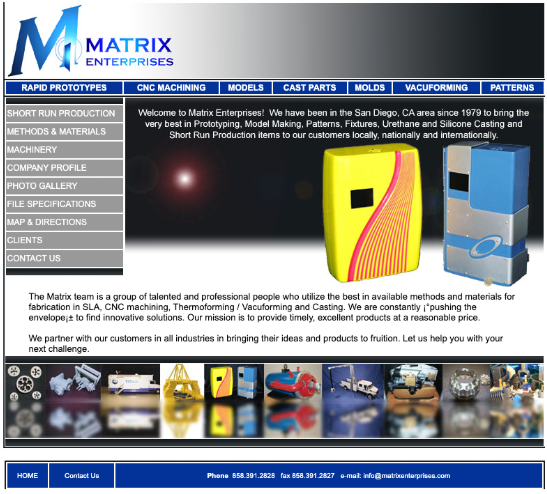
Matrix Enterprises focuses on silicone and polyurethane casting for prototypes and short-run production, selecting materials to match part requirements. Typical parts include keypads, gaskets, housings, boots, covers, bumpers, wipers, and insert-molded items.
Their tooling options include silicone or polyurethane molds cast around a master (SLA-printed, CNC-machined, or customer-supplied) and acrylic molds machined directly for multi-cavity needs. Silicone molds are used when fine detail is critical or when casting urethane parts; polyurethane molds are used when casting silicone parts or when extended mold life is a priority.
Urethane casting offerings:
- Master sources: Accepts SLA, CNC, or customer-supplied masters for mold creation.
- Tooling options: Builds silicone or polyurethane molds around masters; machine acrylic molds for multi-cavity runs.
- Material range: Casts rigid and elastomeric urethanes across broad hardness ranges for functional components.
- Part types: Produces keypads, gaskets, housings, covers, bumpers, wipers, and insert-molded items.
Other manufacturing and production services:
- Rapid prototypes: Builds appearance and functional models to support early design reviews.
- CNC machining: Machines masters, fixtures, and end-use parts from plastics and metals.
- Models: Fabricates display and engineering models for form, fit, and presentation needs.
- Molds: Produces silicone, polyurethane, and acrylic molds tailored to material and mold-life requirements.
- Vacuum forming / thermoforming: Forms plastic sheets into enclosures, guards, and panels for prototype and short-run needs.
- Patterns: Creates accurate patterns for casting workflows and iterative design changes.
5. PolyCraft Tech
Year founded: 1997
Location: Poway, California, USA
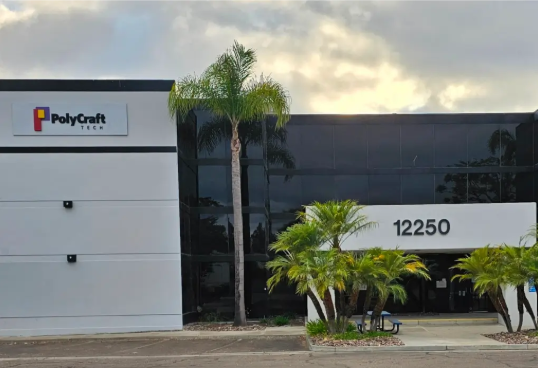
PolyCraft Tech specializes in urethane casting and custom plastic fabrication for complex, high-requirement parts, from large enclosures to small components with fine features, supported by ISO-9000/AS9100 quality management and inventory control. The team designs soft molds for low-volume casting and builds precision components in a range of urethane chemistries to meet functional, cosmetic, and regulatory needs across aerospace, medical, automotive, and industrial applications.
PolyCraft Tech provides mold design, master pattern build or intake, and casting of rigid and elastomeric parts with specified textures and features. Engineering, manufacturing, and quality staff manage requirements through production, using a facility equipped for high-precision fabrication and controlled processes.
Urethane casting solutions:
- Soft-tool molds: Designs and builds silicone/soft molds for low-volume casting and iterative updates.
- Master patterns: Creates or accepts customer-supplied masters for moldmaking and replication.
- Material range: Casts rigid and elastomeric urethanes across specified durometers for functional and cosmetic parts.
Other manufacturing and production services:
- Custom plastic fabrication: Builds complex shapes and high-quality finishes with precision cutting, assembly, and soft tooling to reduce start-up costs.
- Rapid prototyping: Produces accurate prototypes with feedback-driven refinements and a clear transition path into production.
- Post-processing and finishing: Applies painting, color matching, surface treatments, and coatings to enhance appearance and durability.
- Over-molding: Integrates multiple materials into a single component using qualified resins and substrates for added function.
- Precision assembly: Assembles complex multi-part builds to tight tolerances as a single-source delivery.
6. Prototek Digital Manufacturing

Year founded: 1987
Location: Contoocook, New Hampshire
Prototek provides silicone and urethane casting for prototype and short-run production, starting from a master pattern (SLA/QuickCast, material jetting, or CNC) that’s hand-finished and molded in silicone to capture detail.
Tooling options include box, cut, 3D-printed, and gravity molds, selected to match geometry and volume needs. Every order follows a defined workflow from quote to inspection and shipment, supported by certifications including ISO 9001:2015, AS9100D, and ITAR registration.

Urethane casting solutions:
- Master patterns: Builds via stereolithography/QuickCast®, material jetting, or CNC; hand-finish to optimize surface quality.
- Silicone tooling: Produces box and cut molds; offers 3D-printed and gravity molds for specific use cases.
- Materials & finishes: Provides production-grade urethane selections with standard or painted finishes; clear parts supported via polished masters.
Other manufacturing and production services:
- 3D printing: Offers laser sintering, multi-jet fusion, stereolithography/QuickCast®, DLP, fused filament fabrication, hybrid photosynthesis, material jetting, and post-processing.
- Sheet metal fabrication: Provides bending and forming, laser cutting, and waterjet cutting for brackets, enclosures, and structural parts.
- Injection molding: Supplies prototype through production molding with tool build and program support.
- CNC machining: Delivers milling, routing, turning, and sinker/wire EDM for metals and plastics.
7. SyBridge Technologies

Year founded: 2019
Location: Itasca, Illinois
SyBridge Technologies delivers advanced manufacturing solutions that connect design, prototyping, and production through a single digital platform.
SyBridge builds master patterns via CNC or 3D printing, creates silicone tooling, and casts under vacuum/pressure to reproduce complex geometry and fine surface detail without hard tooling.
The company combines expertise in tooling, molding, and additive manufacturing with data-driven technologies to accelerate speed to market for global customers. Its platform, SyBridge Connect, provides cloud-based project visibility, collaboration tools, and real-time production insights for seamless lifecycle management.
Urethane casting solutions:
- Materials (Shore D): ABS-like, PC-like, PE-like, PP-like; high-impact, high-temp, UL94 V-0, Nylon/Delrin-like; FDA variants; optical-clear options.
- Elastomers (Shore A): Standard and high-performance grades, water-clear elastomers, and standard/medical-grade silicones.
Other manufacturing and production services:
- 3D printing: Provides six additive technologies with broad material options to support parts from prototype through full-scale production.
- CNC machining: Delivers tight-tolerance machining in metals and plastics with scalable throughput for complex components.
- Injection molding: Manufactures plastic parts across development stages, including bridge-to-production molding solutions.
- Sheet metal: Produces cut, formed, and assembled sheet-metal parts with laser capability and engineered design support.
- Manufacturing intelligence: Supplies real-time machine and process data to monitor performance and reduce unplanned downtime.
- SyBridge Connect: Offers a secure, web-based platform for quoting, collaboration, project tracking, and digital manufacturing management.
8. TPC, Inc

Year founded: 1972
Location: Fontana, California, USA
TPC, Inc. focuses on custom polyurethane molding for industrial parts that need durability, abrasion resistance, and precise fit. The team produces open-cast and injection-molded urethane components, wheels, sheets, tubes, bumpers, bushings, and custom forms, built to customer drawings or reverse-engineered from samples. In-house machining (lathes, mills, grinders) finishes parts to spec and supports tight, repeatable fits.
Projects are supported by material selection and compounding, including flame-retardant, UV-resistant, and static-dissipative additives. TPC collaborates from early design through production, using tooling and process controls to match geometry, hardness, and surface requirements for applications across transportation, oil & gas, aerospace, fitness, and defense.

Urethane casting solutions:
- Master patterns: Starts from customer CAD or physical samples, perform reverse engineering to create production masters.
- Casting methods: Runs open-casting and injection-molding workflows with controlled cure schedules; post-machines for final dimensions.
- Materials and finishes: Formulates polyurethane elastomers across broad Shore A–D ranges with optional flame-retardant, UV-resistant, and static-dissipative additives; provide turned, milled, or ground finishes.
Other manufacturing and production services:
- Urethane dunnage: Custom-fit polyurethane dunnage designed for cargo protection during transport, automation, and logistics. Manufactured in any size, color, or hardness to absorb impact and prevent product damage.
- Motor mounts: Molded urethane mounts that resist vibration, oil, grease, and abrasives, extending equipment life across automotive, marine, and industrial applications.
- Rods: Abrasion- and crack-resistant polyurethane rods produced in standard and custom sizes with options for FDA-approved, high-temperature, or high-rebound formulations.
- Rollers: Durable urethane rollers engineered for heavy-load performance and wear resistance, available in multiple durometers, colors, and bonding technologies.
- Sheets: Cast polyurethane sheets with customizable hardness, thickness, and color for industrial and fabrication use, providing long-term flexibility and strength.
9. Uniflex Inc

Year founded: 1979
Location: Brighton, Michigan, USA
Uniflex manufactures custom molded polyurethane (cast urethane) parts for industrial, automotive, and utility uses. The team helps turn a drawing, or a physical sample, into a working part by designing the mold, casting the polyurethane, and adding any needed machining.
Projects can start with a single prototype and scale to short-run or ongoing production. Parts are built to your specs: size and shape (geometry), hardness (durometer), and color, with options like bonding polyurethane to metal. Common outputs include rollers and wheels, protective covers, dunnage, bumpers, bushings, seals, gaskets, liners, and body blocks.

Urethane casting solutions:
- Custom cast polyurethane: Design-to-part support for molded urethane components spanning soft to high-durometer formulations and custom colors.
- In-house tooling: Mold design and build with options for 3D-printed prototype tooling to validate fit, finish, and geometry.
- Polyurethane-to-metal bonding: Chemical bonding of urethane to metals and other substrates for durable, integrated assemblies.
Other manufacturing and production services:
- Custom molded rubber: Compression and transfer molding for rubber components to customer specifications.
- Injection molding: Plastic part molding across a wide range of shapes and hardness ranges.
- Precision machining: Tight-tolerance CNC support for polymer and metal features.
10. Xometry

Year founded: 2013
Location: North Bethesda / Gaithersburg, Maryland, USA
Xometry operates an AI-driven online marketplace that connects buyers with a vetted network of manufacturers, rather than producing parts in its own facilities. It handles quoting, engineering evaluation, quality assurance, and project management centrally, while relying on external partners for actual manufacturing.
Xometry offers urethane casting services and provides various combinations of materials, finishes, tolerances, and certifications such as ISO 9001:2015, ISO 13485, AS9100D, and IATF 16949.
Urethane casting solutions:
- Master patterns: Creates SLA or PolyJet master patterns for high-detail replication and smooth surface finish. Patterns are hand-finished before moldmaking to ensure cosmetic precision.
- Silicone tooling: Encapsulates master patterns in RTV silicone to produce flexible molds that capture intricate features and fine textures. Each mold is cut and vented for consistent flow and release.
Other manufacturing and production services:
- 3D printing services: SLA, SLS, MJF, PolyJet, FDM, DMLS, and others, with inspection options and application-appropriate materials for concept checks through functional prototypes.
- CNC machining: Milling and turning for metals and plastics, tight-tolerance features, DFM collaboration, post-processing, and inspection reports.
- Injection molding: Prototype to production programs using a managed supplier network, tool design support, specialty molding such as inserts and overmolds, and program oversight.
- Sheet metal fabrication: Laser cutting, forming, bending, hardware install, and assembly suitable for enclosures, brackets, and structural components.
- Die casting: Managed partners deliver aluminum and zinc castings with repeatable geometry and finishing choices for end-use assemblies
How to Evaluate Urethane Casting Services
Choosing the right urethane casting partner shapes your timeline, unit cost, and part quality. Ask how they handle design changes, cosmetic standards, and repeatability across small batches.
When evaluating urethane casting vendors, look for companies that:
- Customer-driven collaboration: Ask targeted questions about use case, quantities, cosmetic class, inserts, and assembly. Propose practical tradeoffs on durometer, wall thickness, and gating to hit your goals.
- Transparent communication: Provide a named project contact, clear build calendars, and proactive risk flags on mold life, geometry traps, or schedule impacts. Share status at each milestone.
- Design consultation and customization capabilities: Review CAD for draft, venting, and parting-line placement. Recommend master pattern strategies, texture options, color matching, paint stacks, and insert design that speed production.
- Tooling capabilities and lead times: Build RTV silicone tools sized for your volumes with stated mold-life ranges. Offer fast turns on masters, box or cut molds, and re-pours. Define changeover times for revisions and repeat orders.
- Quality assurance and precision: Publish typical tolerances and shrink assumptions. Use pressure casting for opaque parts and vacuum casting for clear parts. Provide inspection reports on request and document color targets, gloss, and texture callouts.
- Material flexibility and expertise: Stock rigid and elastomeric urethanes across Shore A to Shore D, plus clear grades and UL 94 options. Advise on equivalents for ABS-like, PP-like, PC-like, and glass-filled nylon-like behavior, as well as silicone selections.
- Advanced technical capabilities: Support inserts, overmold-style builds, threaded features, and optical-clear finishing. Offer paint, EMI shielding, surface polishing, texture replication, and light post-machining when required.
- Long-term fit: Scale from prototype to pilot with consistent cosmetics and documentation. Maintain certifications that match your industry needs and keep digital records for easy reorders and revisions.
Partner with the Best Urethane Casting Service Company in the US
Finding a supplier that manages both prototyping and production under one roof reduces delays, rework, and communication gaps. It also pays to choose a partner that offers tooling flexibility, material support, and clear engineering input early in the process.
Quickparts is built to help teams move faster, lower risk, and scale with confidence. Design validation, bridge builds, and production all run within a single program, so manufacturing adapts to your timeline and complexity without sacrificing quality.
You get direct access to engineering support at the start, which helps catch issues before they become costly. With in-house production and a network of vetted manufacturers, you gain control, visibility, and consistent results across every phase.
Need a quote? Upload your CAD files through the QuickQuote platform to get transparent pricing along with DFM input and material recommendations, so you can make informed decisions before tooling begins.
Ready to create a prototype or start a low-volume run?
Get your free quote with Quickparts today.
Urethane Casting Services FAQs
What is the process of urethane casting?
Urethane casting begins with creating a master pattern, usually 3D printed with SLA for high accuracy and smooth finish. This master is encased in liquid silicone, which cures into a flexible mold that captures all details. The mold is then filled with liquid polyurethane resin under pressure or vacuum, depending on opacity or clarity requirements. After curing, the part is removed, trimmed, and finished. This process repeats until the desired quantity is reached, usually supporting 20–25 castings per mold before retooling.
What is the difference between urethane casting and injection molding?
The difference between urethane casting and injection molding is that urethane casting uses soft silicone molds and liquid resins, while injection molding relies on hard metal tooling and molten thermoplastics.
Casting is best for low-volume, fast-turn projects that need production-quality finishes without high tooling costs. Injection molding, by contrast, suits high-volume production where the upfront mold investment is offset by longer tool life and lower per-part costs. Urethane casting bridges the gap between prototyping and full-scale production, offering flexibility, speed, and affordability.